
How to Bleed Radiators with a Heat Pump System: A Homeowner's Guide
- James

- 2 days ago
- 13 min read
Did you know that applying traditional boiler maintenance habits to your modern low-carbon heating system could accidentally leave you in the cold? It is frustrating to hear that tell-tale gurgling in your pipes or feel a stubborn cold spot at the top of a radiator, especially when you have invested in advanced technology to future-proof your home comfort. Learning how to bleed radiators with a heat pump system is a vital skill for the proactive homeowner, yet it requires a more calculated approach than the fossil-fuel systems of the past.
We understand that the fear of a system 'lock out' due to low pressure can make basic maintenance feel daunting. This guide simplifies the process, promising to teach you the specific steps to release trapped air safely whilst maintaining peak efficiency. As the UK moves towards the Future Homes Standard, mastering these domestic essentials ensures your environmental investment delivers the warmth you expect. You will discover how to identify air pockets, manage the bleeding process, and perform the critical post-maintenance pressure checks required to keep your system running perfectly.
Key Takeaways
Understand how trapped air creates 'cold bridges' that force your air source heat pump to work harder than necessary to maintain your comfort.
Master the precise methodology for how to bleed radiators with a heat pump system to ensure air is purged whilst maintaining the integrity of the sealed system.
Learn why steady pressure is critical for modern air source heat pumps and the vital role of the expansion vessel in preventing system lock-outs.
Discover the 'two-person job' technique for using the filling loop to re-pressurise your system safely after performing domestic maintenance.
Recognise the specific warning signs, such as persistent air pockets, that indicate a professional maintenance and servicing intervention is required.
Table of Contents
Why Bleeding Radiators is Critical for Heat Pump Efficiency
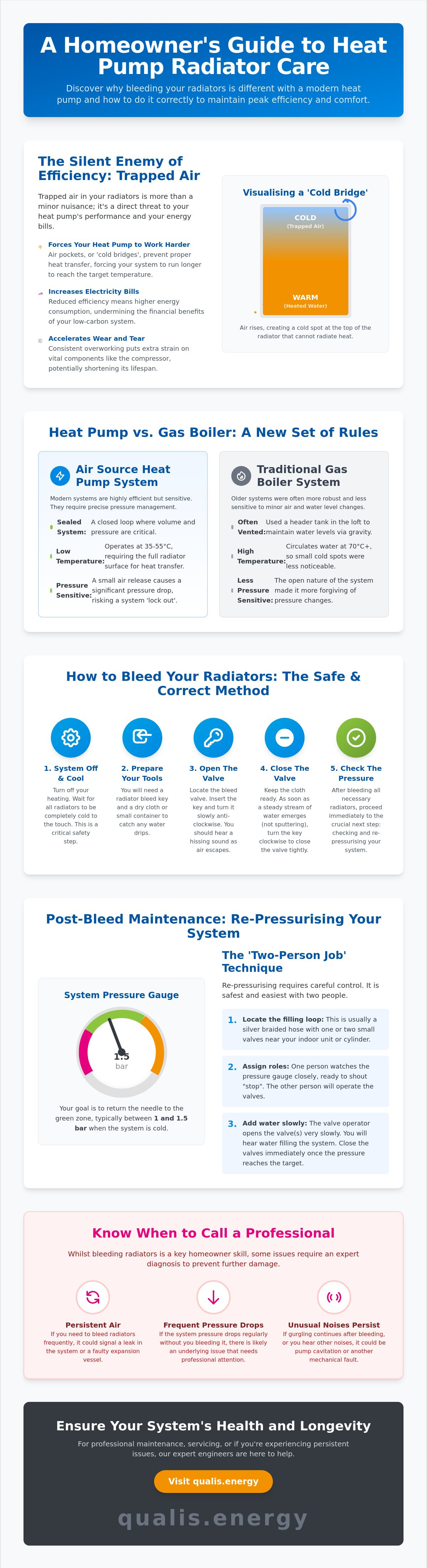
Efficiency is the cornerstone of the UK's transition to low-carbon heating. Whilst your air source heat pump is a marvel of modern engineering, its performance depends entirely on the health of your internal pipework. Trapped air is the silent enemy of this efficiency. It creates 'cold bridges' within your radiators, which are essentially dead zones where heat cannot reach the room. When these pockets exist, your heat pump is forced to work significantly harder to reach the target temperature set on your thermostat. This isn't just a matter of comfort; it's a matter of hardware longevity. Consistent overworking leads to increased compressor wear and, inevitably, higher electricity bills that undermine the financial benefits of switching from gas.
Recognising the symptoms early is vital for maintaining a healthy system. You might notice a distinctive gurgling sound as water struggles to move past air locks, or perhaps your rooms are simply taking longer to reach a comfortable temperature. The most common sign remains a radiator that is cold at the top but warm at the bottom. To resolve this, you'll need to locate the bleed screw on each unit to release the pressure. Understanding how to bleed radiators with a heat pump system is a fundamental part of the modern homeowner's toolkit, ensuring that every unit of electricity consumed is converted into usable heat.
The Impact of Air on Low-Temperature Heating
Unlike traditional gas boilers that circulate water at 70°C or higher, air source heat pumps are designed to operate at lower, more efficient temperatures, typically between 35°C and 55°C. Because the water is cooler, the system relies on the entire surface area of your radiators to transfer heat effectively. Trapped air pockets act as a thermal insulator, preventing the circulating water from making contact with the radiator's metal surface and effectively rendering that portion of the unit useless. This disruption reduces the 'delta T', the temperature difference between the water entering and leaving the radiator, which is the metric your heat pump uses to modulate its performance. When this balance is off, the system's flow rates become erratic, and efficiency plummets.
When to Bleed: Seasonal vs. Reactive Maintenance
Precision is key when managing a sealed heating system. We recommend a proactive approach, performing a full system check every autumn before the first frost hits regions like Nottingham or Sheffield. Air can enter your radiators through microscopic leaks or may have been present in the fresh water used during the initial installation. Whilst reactive bleeding is necessary if you hear noises, seasonal maintenance prevents the heat pump from starting the winter at a disadvantage. It's also important to distinguish between trapped air and pump cavitation. If bleeding doesn't solve the issue, the problem might lie with the pump's ability to move water, which requires a professional look. Mastering how to bleed radiators with a heat pump system ensures you can handle the simple tasks, leaving the complex diagnostics to the experts.
Heat Pump vs. Gas Boiler: The Pressure Difference
Transitioning from a traditional gas boiler to an air source heat pump involves more than just a hardware change; it's a shift in how your home manages energy. Most older gas systems were "vented," meaning they used a header tank in the loft to maintain water levels via gravity. In contrast, your heat pump operates as a sophisticated "sealed system." This configuration is far more efficient at moving heat, but it's also significantly more sensitive to volume changes. When you master how to bleed radiators with a heat pump system, you're interacting with a closed loop where every millilitre of air or water matters.
Inside this loop, the expansion vessel plays a critical role. It acts as a pressure-regulating cushion, absorbing the natural expansion of water as it warms. However, when you open a bleed valve to release trapped air, you're effectively removing volume from this sealed environment. This action causes an immediate and measurable drop in system pressure on your gauge. Because of this, safety is paramount. You must ensure the system is entirely cold before you start. Bleeding a live, hot system can cause water to expand rapidly, leading to erratic pressure readings and potential injury from escaping steam.
Locating Your System Pressure Gauge
You'll find your pressure gauge either on the front panel of the indoor unit or on the pipework near your hot water cylinder. Analogue gauges use a physical needle, while newer models feature digital displays on the main controller. For most UK homes, the "green zone" or ideal resting pressure is between 1.0 and 1.5 bar when the system is off. If the needle drops below 1.0 bar after bleeding, the system will likely require a manual top-up to remain operational. Understanding this baseline is the first step in maintaining a healthy, high-performing home environment.
The Risk of 'Low Pressure' Lockouts
Modern heat pumps are intelligent. They require a minimum bar pressure to even start the compressor to prevent damage to internal components. If you bleed too much air without re-pressurising, you might trigger a "low water pressure" error code. This safety lockout shuts the system down entirely to protect the hardware. To avoid a cold house mid-maintenance, check the gauge after every one or two radiators. If you're unsure about your system's specific requirements, a professional maintenance & servicing check can provide the clarity you need. This proactive approach ensures your journey towards a lower carbon footprint remains smooth and uninterrupted.
Step-by-Step Guide: Bleeding Your Radiators Safely
Precision is the hallmark of a high-performance home. To begin your maintenance, gather an essential kit consisting of a standard radiator key, a thick absorbent cloth, and a small container to catch any drips. Unlike older gravity-fed systems, the order in which you work through your home matters immensely for a sealed ASHP circuit. You should always start at the lowest point of your property, typically the ground floor radiators furthest from the heat pump, and work your way upwards to the highest floor. This logical progression ensures that air is systematically purged rather than simply shifted between different levels of your pipework.
Preparation and Safety Protocol
Before you touch a single valve, you must switch off your air source heat pump via the main controller or the external isolator. This stops the internal circulator pump from moving water, which allows any trapped air to rise naturally to the top of each radiator. Waiting between 30 and 60 minutes for the water to settle is non-negotiable. This pause is critical to ensure you aren't chasing micro-bubbles through the system whilst you work. Always place your absorbent cloth directly beneath the valve before opening it. The water inside a modern sealed system contains chemical inhibitors designed to prevent internal corrosion, and these fluids can permanently stain carpets or specialist wooden flooring if they are allowed to splash.
The Bleeding Process
When the system has settled, insert your key into the bleed valve at the top of the radiator. Apply the 'Quarter-Turn' Rule: never rotate the key more than 90 degrees. Unscrewing the valve too far is a common mistake that can lead to the internal pin falling out entirely, which results in an uncontrollable leak that can rapidly drain your system's pressure. Listen carefully for the characteristic hiss of escaping air. Once the sound ceases and you see a steady, bubble-free stream of water, the air lock is gone.
If you encounter a stubborn valve that has been painted over during home renovations, use a small amount of penetrating oil and gentle pressure rather than brute force. Close the valve securely as soon as the water appears, but avoid over-tightening the delicate brass thread, as this can cause the metal to shear over time. Mastering how to bleed radiators with a heat pump system is a process of patience and technical care, ensuring that your home's transition to green energy remains both comfortable and reliable.
Post-Bleed Maintenance: Re-Pressurising Your ASHP
Restoring the equilibrium of your heating circuit is the final, crucial stage of the process. As we established earlier, removing air from your radiators inevitably reduces the total volume of fluid in your sealed system, leading to a drop in pressure. If you have followed the steps on how to bleed radiators with a heat pump system, your gauge will likely now sit below the recommended 1.0 bar threshold. To rectify this, you must engage the filling loop. This is not merely a technical box-ticking exercise; it is a vital step in ensuring your heat pump can modulate its performance correctly and avoid a frustrating system lockout.
Success in this phase often requires a collaborative approach. We recommend treating re-pressurisation as a 'two-person job' to ensure absolute precision. One individual should remain at the ASHP controller or the analogue gauge, whilst the other operates the valves on the filling loop. This real-time feedback loop prevents over-pressurisation, which can stress the expansion vessel and potentially trigger the pressure relief valve. Once the system is back within the green zone, you may find that a second round of bleeding is necessary. As the water begins to circulate again, it can dislodge minor air pockets from the pipework, carrying them into the radiators where they can finally be purged.
Using the Filling Loop Correctly
The filling loop is typically a silver flexible hose located near your internal unit or hot water cylinder, connected by two black-handled valves. To top up the pressure, you must open both valves slowly, allowing fresh mains water to enter the system. Listen for the sound of flowing water and watch the gauge rise steadily. Aim for a resting pressure between 1.0 and 1.5 bar. If you accidentally enter the 'red zone', usually anything above 2.5 bar, you will need to drain a small amount of water from a radiator bleed valve to bring the levels back down safely. Should you feel unsure about managing these delicate adjustments, booking a professional maintenance & servicing visit can provide total peace of mind.
Verifying System Performance
After re-pressurising, restart your heat pump and monitor the display for any lingering error codes or flow-rate warnings. Check that the flow temperature is climbing towards its design setpoint, usually between 35°C and 55°C, and feel the radiators to ensure heat is distributed evenly across their entire surface. After the system has reached its operating temperature, use a dry tissue to wipe around each bleed screw to ensure no moisture is escaping under the increased pressure. This final check confirms that your maintenance has been successful and your home remains on the path to peak efficiency.
When to Call a Professional Heat Pump Engineer
Whilst knowing how to bleed radiators with a heat pump system empowers you to manage your home's daily comfort, some challenges require a more technical intervention. Precision is paramount in a sealed system. If air returns to the circuit within days of your maintenance, or if your pressure gauge fluctuates wildly between heating cycles, you may be facing a failing expansion vessel. This component is critical for absorbing pressure changes; when its internal diaphragm fails, the system cannot maintain the steady state required for peak efficiency.
Faulty auto-air vents are another common culprit that homeowners should recognise. These small components are designed to purge micro-bubbles automatically, yet when they become blocked or fail, they can inadvertently draw air back into the loop. Identifying these subtle hardware issues is a core part of professional air source heat pump servicing. Scheduled maintenance ensures that your environmental investment is protected, preventing small air-related annoyances from escalating into expensive compressor repairs.
Troubleshooting Complex Air Issues
Sometimes, what feels like an air pocket is actually a more stubborn obstruction. Cold spots at the bottom or centre of a radiator are rarely caused by air; instead, they usually indicate a buildup of magnetite, commonly known as 'sludge'. This debris settles in areas of low flow and acts as a thermal barrier, forcing your ASHP to work harder to overcome the resistance. Whilst modern installations include magnetic filters to capture these particles and protect the heat exchanger, older pipework may eventually require a professional power flush to restore the system's original flow rates and thermal conductivity.
The Value of Local Expertise
Qualis Energy serves as a dedicated partner for homeowners across Nottingham, Sheffield, and Newark, providing the high-level technical expertise needed for this national energy transition. We believe that domestic comfort should be effortless. As MCS-accredited installers, our team focuses on the long-term health of your infrastructure, moving beyond simple fixes to provide comprehensive system optimisations. Choosing a professional maintenance plan removes the burden of technical management from your shoulders, ensuring your system remains quiet, efficient, and reliable through every season.
Book your annual ASHP service with Qualis Energy today to ensure your low-carbon heating system continues to deliver the visionary performance you expect.
Securing Your Home's Low-Carbon Future
Mastering the technical nuances of your heating system is more than just a domestic chore; it's a commitment to the efficiency of the UK's green transition. You've learned that whilst the physical act of purging air remains familiar, the sensitivity of a sealed circuit means knowing how to bleed radiators with a heat pump system requires a precise eye on the pressure gauge. By identifying cold spots early and managing the filling loop with care, you protect your compressor from unnecessary wear and ensure your home remains a sanctuary of consistent warmth.
Maintaining these sophisticated systems often benefits from the steady hand of an expert. As MCS Accredited Installers and local specialists serving Nottingham and Sheffield, we bring high-level technical expertise to every project. Whether you operate Mitsubishi or Daikin ASHP systems, our team is dedicated to removing the effort of complex maintenance from your schedule. Ensure your system is running at peak performance with a Qualis Energy service check to guarantee your environmental investment continues to deliver maximum value. You've taken the first step towards total system confidence, and we're here to support every stage of your journey.
Frequently Asked Questions
Can I bleed my radiators whilst the heat pump is running?
No, you should never bleed your radiators whilst the heat pump is operational. The circulator pump must be stationary to allow air to rise to the top of the radiator for effective venting. If you attempt this whilst the system is active, you'll simply move the air pockets around the circuit rather than purging them. Always isolate the power and wait at least 30 minutes for the water to settle before beginning.
How often should I bleed the radiators in my heat pump system?
An annual check every autumn is the most effective way to manage your system's health. Proactive maintenance ensures your home remains efficient before the peak winter demand arrives. You should also perform a reactive check if you notice cold spots at the top of a radiator or hear distinctive gurgling sounds. Learning how to bleed radiators with a heat pump system ensures you're prepared for these minor domestic adjustments whenever they arise.
What should the pressure gauge read on my heat pump after bleeding?
Your pressure gauge should ideally read between 1.0 and 1.5 bar when the system is cold. This resting pressure provides the necessary volume for the heat pump to operate its compressor safely and efficiently. If the needle falls below 1.0 bar after you've finished bleeding, the system may trigger a low-pressure lockout. Always check the gauge after every two radiators to ensure the circuit remains within its optimal operating parameters.
What happens if I accidentally let too much water out while bleeding?
Letting out too much water will cause a significant drop in system pressure, potentially shutting down your heating entirely. Modern air source heat pumps are highly sensitive to volume changes and will display an error code if the bar pressure is insufficient to start the compressor. If this happens, don't panic. You can easily restore the balance by using the filling loop to introduce fresh mains water until the gauge returns to the green zone.
Why is my radiator still cold at the top after I've bled it?
A radiator that remains cold at the top often indicates a stubborn air lock deeper in the pipework. You may need to repeat the bleeding process after the system has circulated water for a few hours to dislodge the trapped air. However, if the cold spot is at the bottom or centre, this is usually a sign of magnetite or sludge buildup. In such cases, knowing how to bleed radiators with a heat pump system isn't enough, and a professional power flush may be required.
Is the water inside my heat pump radiators safe to touch?
No, you should avoid direct contact with the system water. The fluid inside your radiators is treated with chemical inhibitors and antifreeze agents, such as glycol, to prevent internal corrosion and freezing. These chemicals can be skin irritants and will certainly stain your soft furnishings or carpets if they escape. Always use a thick absorbent cloth and a container to catch any drips during the maintenance process to protect your home's interior.
How do I find the filling loop on my Mitsubishi or Daikin heat pump?
On common Mitsubishi Ecodan or Daikin Altherma systems, the filling loop is typically a silver, braided flexible hose. You'll usually find it located near the indoor unit or the hot water cylinder, connected by two black-handled valves. These valves must be opened simultaneously to top up the system pressure. If you're struggling to locate it, refer to your installer's handover pack or look for the pipework directly connected to the pressure gauge.
Can air in the radiators damage my air source heat pump?
Air pockets won't cause immediate catastrophic failure, but they do lead to cumulative damage over time. Trapped air forces the heat pump's compressor to run more frequently and at higher intensities to compensate for reduced heat transfer. This increased workload accelerates hardware wear and inflates your energy consumption. In extreme cases, large air locks can lead to pump cavitation, which can physically damage the internal circulator pump and require an expensive replacement.


Comments